FROM METRICS TO MEANING: REFRAMING THE USE OF PERFORMANCE DATA IN HIGH-STAKES ENVIRONMENTS
DOI:
https://doi.org/10.64255/mamz1m14Keywords:
Monitoring, military , Decision-Making, Analysis, Injury, Athlete, Technology, AIAbstract
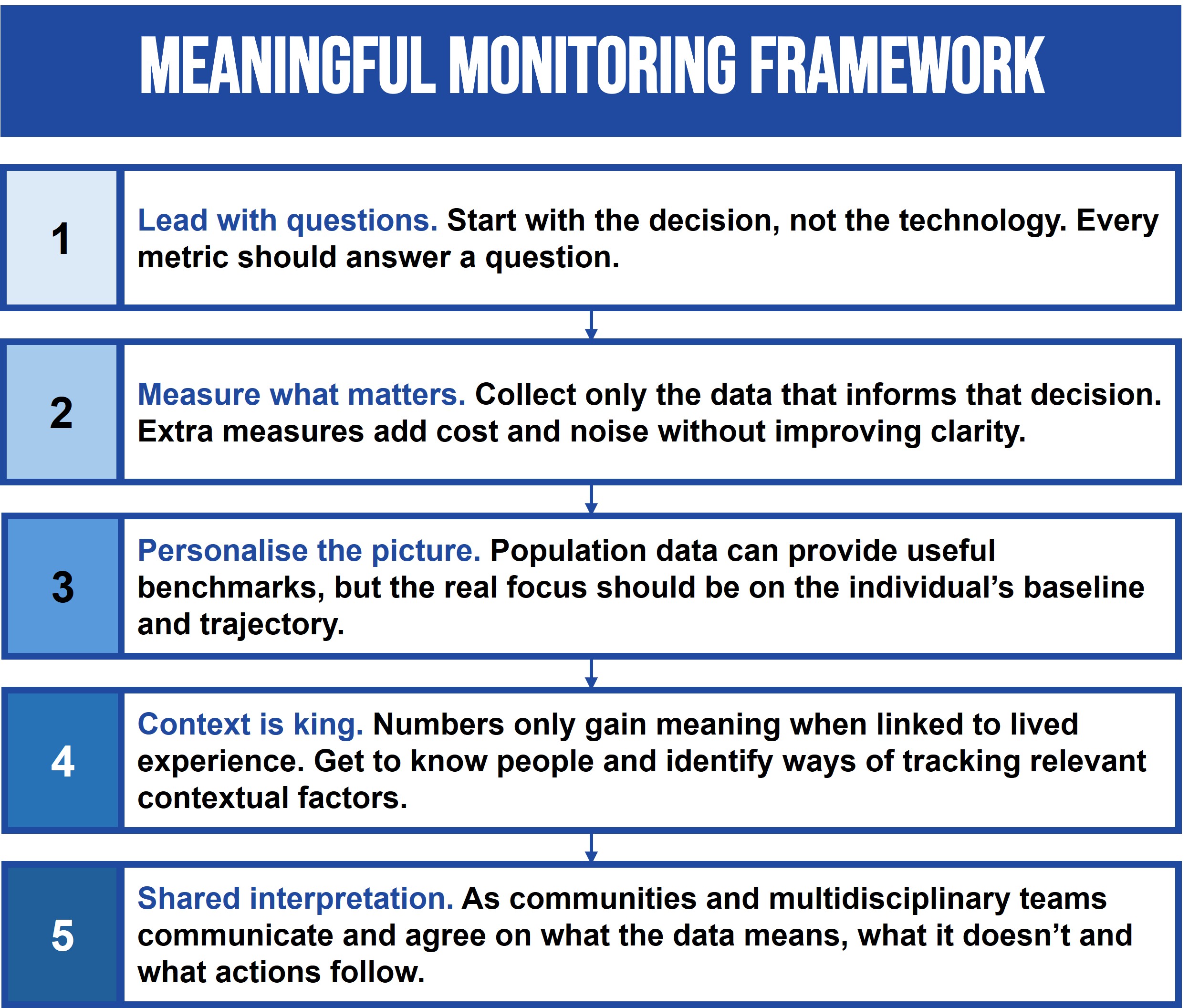
In both elite sport and military performance settings, the proliferation of data collection technologies has led to an era of unprecedented measurement, but not necessarily better decision-making. We challenge the current fixation on data volume and precision, arguing that without context, interpretation and narrative, performance metrics risk becoming noise rather than insight. Drawing on parallels between intelligence analysis and performance monitoring, a reframing of how data is used is proposed: from passive recording to active sense-making. By prioritising meaning over measurement and fostering interdisciplinary fluency between analysts, coaches and athletes, clarity and purpose can be restored to data-driven performance systems. This paper outlines a new framework for using performance data in high-stakes environments, centred around five key principles to encourage ‘leading with questions’, ‘measuring what matters’, ‘personalising the picture’, ensuring that ‘context is king’ and promoting a process of ‘shared interpretation’. This framework proposes that insight, not information, must become the currency of action.
References
1. Meyer VM. Sport psychology for the soldier athlete: a paradigm shift. Mil Med. 2018;183(7–8):e270–e277. doi:10.1093/milmed/usx083
2. Pattyn N, Van Cutsem J, Lacroix E, Van Puyvelde M, Cortoos A, Roelands B, et al. Lessons from special forces operators for elite team sports training: how to make the whole greater than the sum of the parts. Front Sports Act Living. 2022;4:780767. doi:10.3389/fspor.2022.780767
3. Cardinale M, Varley MC. Wearable training-monitoring technology: applications, challenges and opportunities. Int J Sports Physiol Perform. 2017;12(Suppl 2):S255–S262. doi:10.1123/ijspp.2016-0423
4. Buchheit M, Hader K. Data everywhere, insight nowhere: a practical quadrant-based model for monitoring training load vs response in elite football. Sports Perform Sci Rep. 2025;258:1–14.
5. Ekstrand J, Spreco A, Bengtsson H, Bahr R. Injury rates in professional football: the influence of injury definition and data collection on reported incidence. Br J Sports Med. 2021;55(7):427–433. doi:10.1136/bjsports-2020-102611
6. Zhou D, Keogh JWL, Ma Y, Tong RKY, Khan AR, Jennings NR. Artificial intelligence in sport: a narrative review of applications, challenges and future trends. J Sports Sci. 2025. doi:10.1080/02640414.2025.2518694
7. Windt J, Gabbett TJ. How do training and competition workloads relate to injury? The workload–injury aetiology model. Br J Sports Med. 2017;51(5):428–435. doi:10.1136/bjsports-2016-096040
8. Kalkhoven JT, Watsford ML, Impellizzeri FM. A conceptual model and detailed framework for stress-related, strain-related and overuse athletic injury. J Sci Med Sport. 2020;23(8):726–734. doi:10.1016/j.jsams.2020.02.002
9. Clarsen B, Rønsen O, Myklebust G, Flørenes TW, Bahr R. The Oslo Sports Trauma Research Center questionnaire on health problems: a new approach to prospective monitoring. Br J Sports Med. 2014;48(9):754–760. doi:10.1136/bjsports-2013-092627
10. King R, Yiannaki C, Kiely J, Rhodes D, Alexander J. Multi-disciplinary teams in high performance sport: the what and the how – a utopian view or a darker reality. J Expertise. 2024;7(4):149–174.
11. Mathieu JE, Heffner TS, Goodwin GF, Salas E, Cannon-Bowers JA. The influence of shared mental models on team process and performance. J Appl Psychol. 2000;85(2):273–283. doi:10.1037/0021-9010.85.2.273
12. Malone S, Owen A, Mendes B, Hughes B, Collins K, Gabbett TJ. High-speed running and sprinting as an injury risk factor in soccer: can well-developed physical qualities reduce the risk? J Sci Med Sport. 2018;21(3):257–262. doi:10.1016/j.jsams.2017.05.016
13. Bittencourt NFN, Meeuwisse WH, Mendonça LD, Nettel-Aguirre A, Ocarino JM, Fonseca ST. Complex systems approach for sports injuries: moving from risk factor identification to injury pattern recognition. Br J Sports Med. 2016;50(21):1309–1314. doi:10.1136/bjsports-2015-095850
14. Iwasaki Y, Someya Y, Nagao M, Nozu S, Shiota Y, Takazawa Y. Relationship between the contact load and time-loss injuries in rugby union. Front Sports Act Living. 2024;6:1395138. doi:10.3389/fspor.2024.1395138
15. Williams S, Trewartha G, Kemp S, Stokes K. A meta-analysis of injuries in senior men’s professional rugby union. Sports Med. 2017;47(7):1243–1255. doi:10.1007/s40279-016-0633-9
Downloads
Published
Issue
Section
License
Copyright (c) 2025 Author(s) (or their employers).

This work is licensed under a Creative Commons Attribution 4.0 International License.
This license enables re-users to distribute, remix, adapt, and build upon the material in any medium or format, so long as attribution is given to the creator. The license allows for commercial use. CC BY includes the following elements:
 BY: credit must be given to the creator.